From Not Wikipedia, the free-ish encyclopedia
Rock System
This article is about the homemade reminder method. For stacked stone markers, see Cairn.
This article describes a personal method that is ad-hoc, untested, and unsupported by any study. It is not notable by Wikipedia's standards and would there be original research. This page records the idea and its date — see about this project.
The Rock System is an informal method, devised by Peter Jamieson, that uses a fixed grid of small rocks as tangible reminders: some rocks stand for habits to perform that day, and others for ideas the user is trying to keep in mind. Rocks are picked up from the grid in the morning and carried; performing the habit (or ending the day) returns the rock to its cell.8 It has no research behind it and makes no effectiveness claims.
Overview
The system combines two familiar ideas: a physical object carried as a prompt2 and the assignment of meaning to fixed positions in space, as in the method of loci.1 Each rock has a home cell and a meaning; its presence or absence in that cell encodes state for the current day.
Method
Setting up
- Gather a set of small rocks — enough for every habit and idea you want to track, plus a few spare.
- Lay them out in a grid on a sheet of paper (the author uses 4×4).
- Photograph the layout. The photo is the canonical map: it records which rock lives in which cell, so the grid can always be rebuilt.
- Assign each cell a meaning — a habit ("stretch", "exercise", "take vitamins") or an idea to remember ("listen before answering", "ship small").
Daily use
- Morning: pick up the rock for every habit you intend to maintain that day, and one rock for an idea you are working on holding in mind. Carry them (a pocket works).
- During the day: the rocks — and the gaps they leave in the grid — are the reminder. Feeling a rock in your pocket is a prompt to act on it or to recall the idea.
- On completing a habit that is a discrete task (exercise, stretching, a phone call), return its rock to its cell. A full grid means the day's tasks are done.
- End of day: return the idea rock too. The grid resets for tomorrow.
The 4×4 example
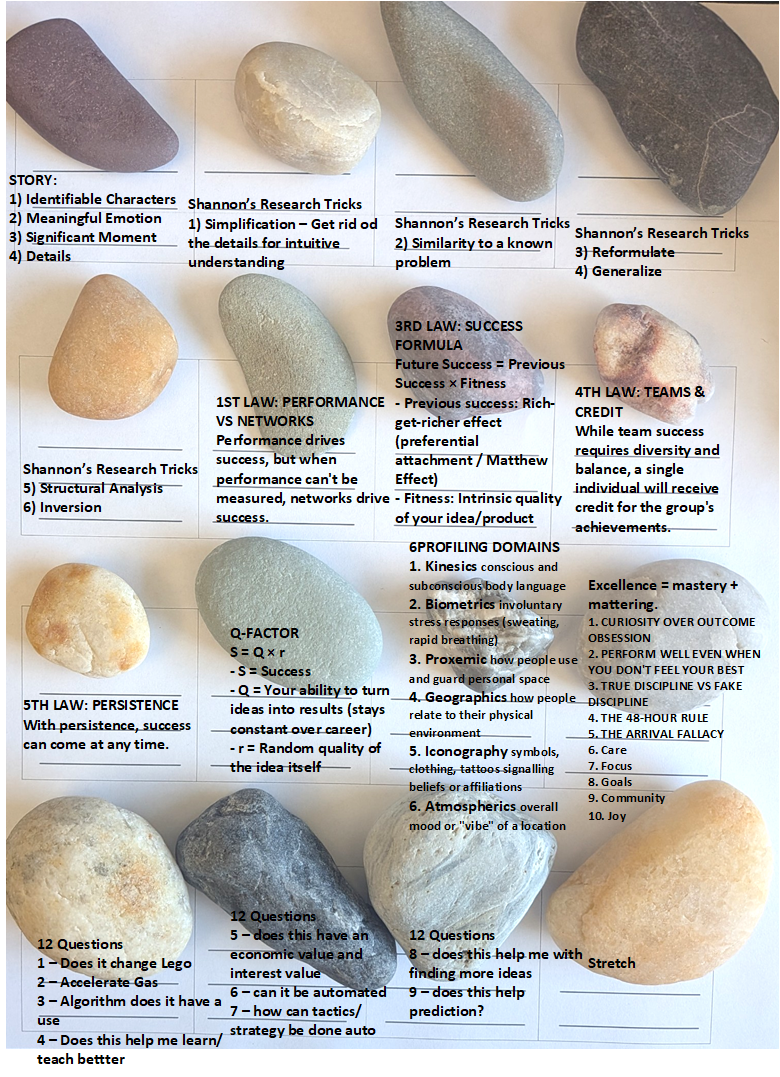
Rationale
The method leans on three everyday effects, none of them specific to rocks:
- Externalising memory. Moving an intention out of the head and onto an object reduces the load of remembering it — the principle behind written to-do lists and Getting Things Done.4
- Spatial meaning. A fixed location per item makes "what is left?" answerable at a glance, as in the method of loci.1
- A physical token. A carried object gives repeated, incidental contact with the reminder through the day, similar to a worry stone.2
Naming
The method is currently just called the Rock System. The author has floated “The Rock Says…” as a catchier name, while noting that the phrase is closely associated with the wrestler and actor Dwayne "The Rock" Johnson and may be encumbered by trademark.7 A safer alternative has not been settled on.
Limitations
- No study supports it; any benefit is anecdotal and may be placebo or simply the effect of any deliberate routine.
- It requires carrying objects and a daily setup ritual.
- It does not scale far beyond one grid, and it records only "done / not done", not amounts or streaks over time.
See also
- Method of loci
- Worry stone · Cairn
- Habit · Getting Things Done
- Canadian Numerals (Not Wikipedia)
References
- "Method of loci". Wikipedia. en.wikipedia.org/wiki/Method_of_loci
- "Worry stone". Wikipedia. en.wikipedia.org/wiki/Worry_stone
- "Habit". Wikipedia. en.wikipedia.org/wiki/Habit
- "Getting Things Done". Wikipedia. en.wikipedia.org/wiki/Getting_Things_Done
- "Tangible user interface". Wikipedia. en.wikipedia.org/wiki/Tangible_user_interface
- "Cairn". Wikipedia. en.wikipedia.org/wiki/Cairn
- "Dwayne Johnson". Wikipedia. en.wikipedia.org/wiki/Dwayne_Johnson
- Method described by Peter Jamieson; not previously documented or published.
This page was last edited on 28 August 2026. Text is available under CC BY-SA 4.0. Not Wikipedia is not affiliated with the Wikimedia Foundation.